






No posts found!
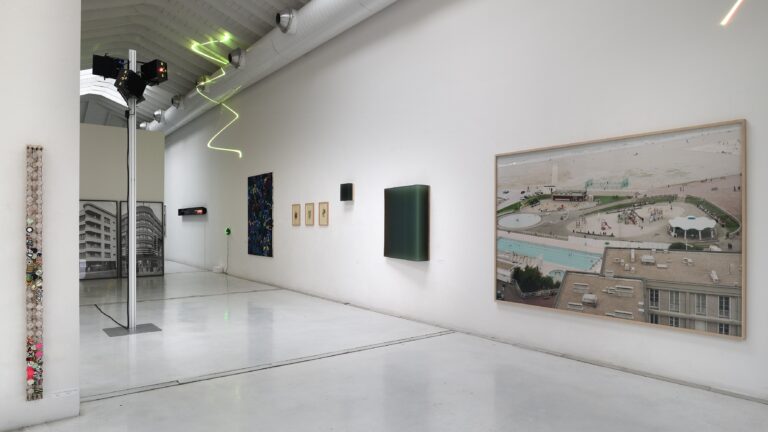
Andrea Fogli, Studio la Città 2010
photo credit: Michele Sereni
Within Andrea Fogli’s body of work, the interaction between conceptual procedure and gestural practice establishes a persistent dialectical syntax.
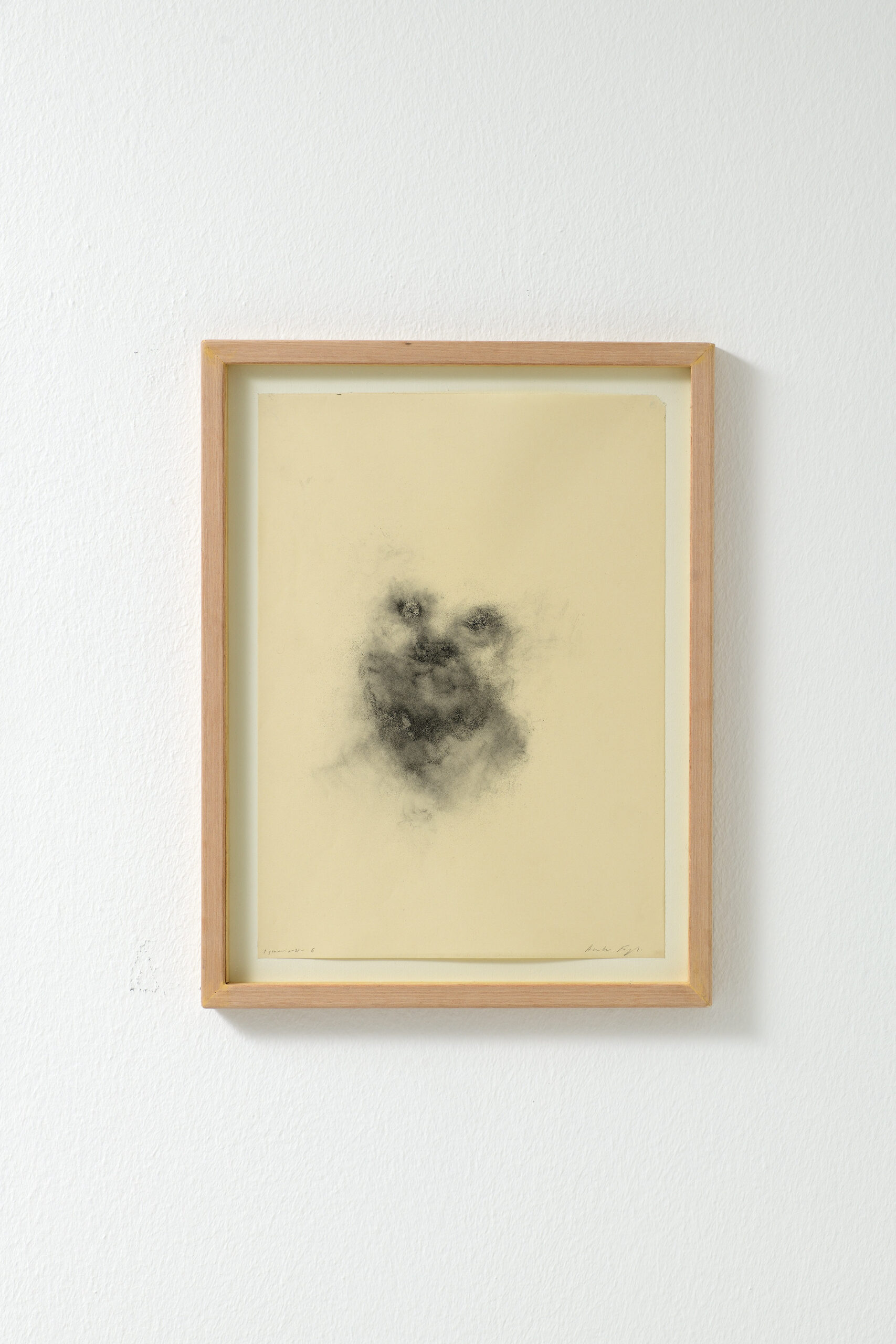
In the works on paper—such as the Diario dei 59 grani di polvere cycle—this dualism manifests through the adoption of a technique that privileges the spontaneous emergence of the image. The artist employs an elemental material such as graphite dust, allowing it to fall from above by means of a brush, thus drawing without direct contact with the paper. This gesture, only partially controlled, enables the surfacing of evanescent, immaterial figures—almost acheiropoietic or phantasmatic images—“not drawn or made by the hand, but rather emerging fortuitously from the sheet.” Fogli himself states that he does not “execute” the image, but instead “discovers” what rises from the dust, activating a psychoscopic imaginal register that in turn engages the viewer’s perceptual and psychic field.
Yet this gestural openness and partial surrender to chance operates within a clearly defined structural intention, not only thematic (the depiction of the face), but procedural: the cycle is ritually conceived to unfold day after day, over fifty-nine consecutive days. The work thus assumes the form of an apocryphal, pantheistic rosary (fifty-nine being the number of beads in the Rosary), in which repetition becomes both temporal discipline and symbolic framework.
The sculptural series Araballi, while remaining consistent with the artist’s recurrent use of materials such as clay and terracotta, enters this dialectical trajectory by introducing a distinct intention toward lightness and irony. Composed of small earthenware vessels topped with miniature terracotta sculptures that often function as “head-lids,” the Araballi are described by the artist as a deliberate departure from the “monastic rigor” that permeates many of his other cycles. Their role as “custodian vessels,” which ironically encapsulate a “world of shadows,” suggests that the intention here is not merely to impose a taxonomic structure—as in the Atlases, where chance is absorbed into a reassuring stability—but also to release the emotional and visionary tone of the work.
If in the dust drawings the almost blind gesture is disciplined by a quasi-mystical seriality, in the Araballi intention takes shape through the transfiguration of interior states, expressed via their strangeness and eccentricity. In both series, the work unfolds within an unstable threshold between intention and chance, between order and play.
Studio la Città, 2025