
MIKHAEL SUBOTZKY, Sticky-Tape Transfer 64 -Jacaranda/Hermanus, 2023
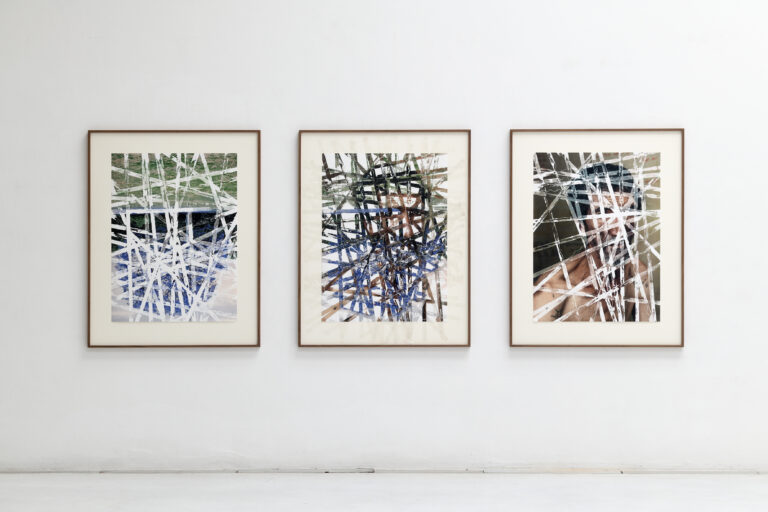
Mikhael Subotzky, Sticky-Tape Transfer 64 -Jacaranda/Hermanus, 2023 |
Photo Credits: Michele Alberto Sereni
There’s something very appealing and challenging in his work: the balance he maintains in addressing complex themes rooted in the relationship with time, the concepts of family and generation, and questions of identity and belonging emerging from the context of a country as complex as South Africa.
I’ve been investigating visually these works and I came up with the understanding that the “Sticky Tape” technique [1] recreates mental thinking and cerebral dreams in visual form: time stretches and merges through the overlapping of images, an intellectual process more commonly associated with neuroscience than with art; the tryptic Jacaranda/Hermanus, 2023 is the culmination of this process and is, in my view, the pinnacle of his intellectual research. Familiar links (with his father), historic “frustration” (in his country of birth), other elements, all seen through a third eye that compresses and annihilates time, the impelling desire to use photography as a unique media art production tool, rather than a reproduceable one. he manipulates time that is no longer unidirectional as we all live by, not frozen, as in a photographer’s basic day 1 lesson, maybe progressive, in the sense that we’ve known
a little more about Hermanus [2] after every exhibition. He plays with time as a boy with dreams, the following morning all seem accumulated, some things seem to have come first but what dominates is the memory of the dream as a whole, it never starts and never ends.
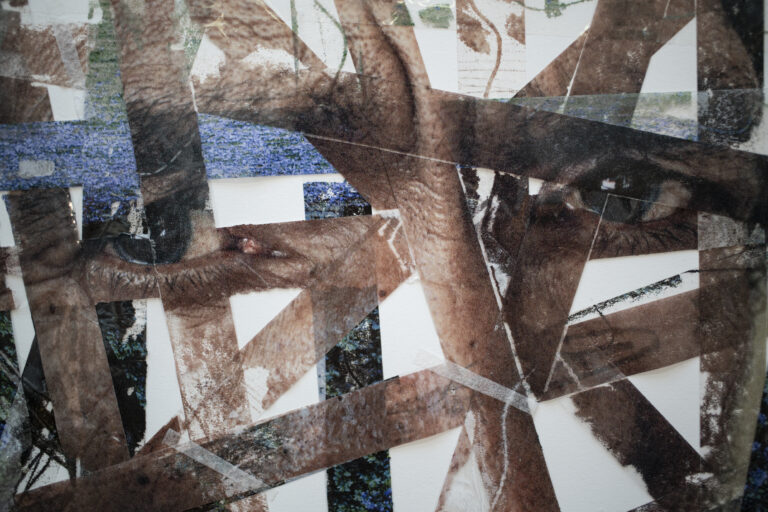
Sticky-Tape Transfer 64 – Jacaranda/Hermanus – detail
With the sticky tape technique series this research progresses further, he takes time from one image and blends it with the time of the other image to build a third one with its own time, this results in a third image that could not exist without the other two, so we should consider it a consequence but also remember it the idealistic cause of the choice of the two original ones: which one comes first? Cause or consequence? Neither, time is overplayed by the third eye.
Mikhael Subotzky transforms photography into painting; he shifts and overturns the very entry point to the photographic medium, turning it into a passionate and incisive instrument — a Copernican revolution compared to its habitual neutrality. We grew considering the photographer and the viewer as absolutes who define the photograph they see: advertising? Art? Documentation? An endlessly reproducible extract? No longer…
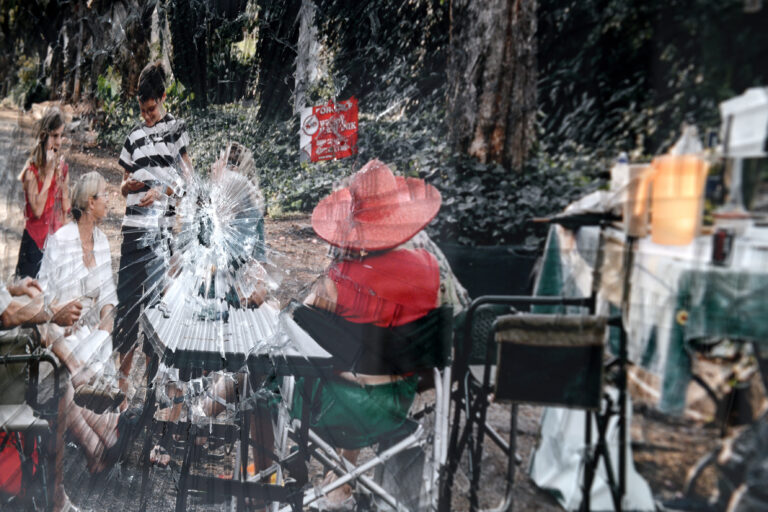
Mikhael Subotzky, Street Party, Saxonwold, 2008 – detail
When Mikhael smashes the glass of his own print, he dips in and out of it, destroys the image’s frozen instant, loosens the concepts of portrayed subject and content, he upsets its viewing with no lectures given, no need to lead the way; and given the themes he touches and country he lives in, it would be far easier to draw the viewer’s attention to those political issues, social conflicts, global unhappiness, or, with simple wording, the basic underpins of the research of so many artists of this century, those same artists who are waiting for him to cross that line to join their grumbling side. He never does that; why? Because he’s an artist.
Art is art, everything else is everything else.
| Francesco Sutton, Principal – Studio la Città
[1] Sticky Tape: the artist uses ordinary adhesive tape to transfer images. The process involves three main steps: Sticky tape is applied onto an inkjet-printed photograph (sourced from encyclopedias, manuals, or personal archives); the tape is gently peeled away, lifting the ink pigment off the paper; this lifted pigment is then used to create an entirely new piece of work. The final artworks are either presented as structured, framed triptychs (like the tryptic Jacaranda/Hermanus) or as free-flowing, semi-transparent structures.
[2] Hermanus is a former South African prisoner whose personal story and relationship with the artist Mikhael Subotzky play a central role in the artist’s work. Subotzky first met Hermanus in 2005 at the Icon Building construction site in Cape Town; Hermanus was initially portrayed in the work Hermanus (on Mattress) Icon Building, part of the Umjiegwana series dedicated to the prison system and post-release reintegration. This initial encounter gave rise to an ongoing artistic and biographical collaboration. In the years that followed, Hermanus became a recurring presence in the photographer’s projects, playing a fictionalised version of himself in the film WYE (2016) and appearing in Epilogue: Disordered and Flatulent (2022). His life story was also the subject of a recording and documentary collection project in 2021 at the A4 Arts Foundation in Cape Town, South Africa.
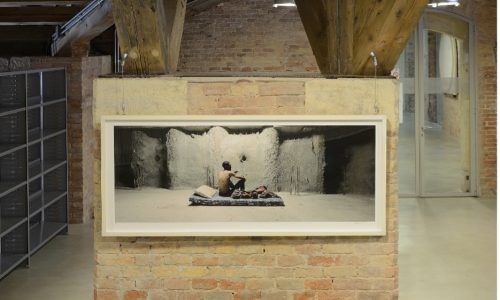
Mikhael Subotzky, Hermanus (on Mattress) Icon Building, 2005, Museo del Contemporaneo (Università degli Studi di Verona)