
LUCAS REINER, Renaissance Removal Paintings
Nine paintings on show at Studio la Città
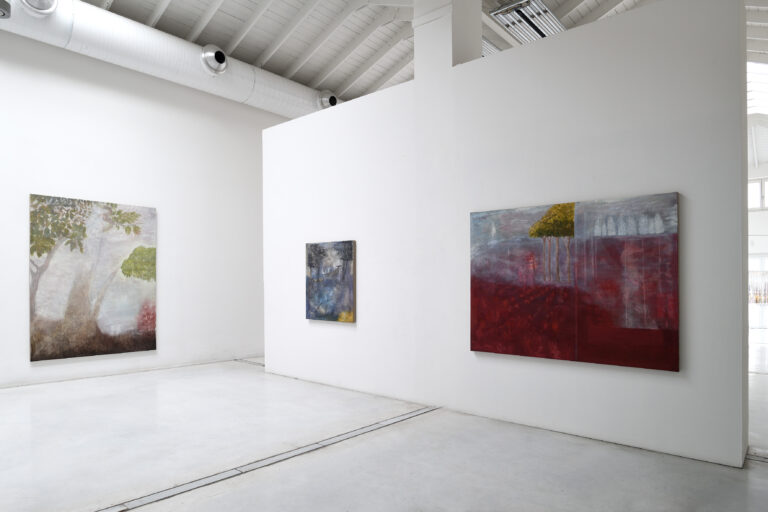
Lucas Reiner, Renaissance Removal Paintings, Studio la Città, 2026
Photo credit: Michele Alberto Sereni
Renaissance Removal Paintings marks new territory for Studio la Città. The gallery has long championed artists whose practices are grounded in reduction – of colour, gesture, and form. Within this lineage, formal rigor could occasionally be activated by the introduction of a second colour, a second mark, or a second form. Yet such additions were always intended to remain almost imperceptible: a subtle inflection of colour, a slight shift in gesture, a faint shadow cast across form. This secondary, metaphorical intervention intensified the work’s conceptual force while opening new interpretive possibilities, making the composition only apparently more intricate.
The radical departure proposed by Renaissance Removal Paintings lies instead in an additive painterly process that fundamentally reorganises pictorial space. Here, new layers of paint construct a renewed relationship between figure and ground – no longer sequential or hierarchical, but dialogical. Lucas Reiner amplifies the perspectival tension between the absent (or removed) figures and the landscapes they once inhabited, deepening the contextual framework of the biblical narratives that underpin Judeo-Christian visual culture. His project dismantles the compositional logic of Renaissance painting in order to unfold its etymological and theological meaning [1].
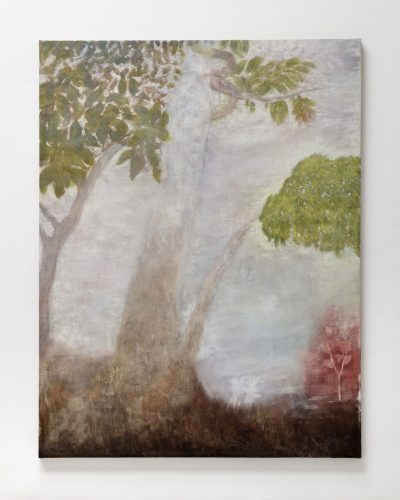
Lucas Reiner, Adam and Eve, or The Garden, 2026
Photo credit: Michele Alberto Sereni
Each work retains the exact dimensions of its Renaissance source image. The central figures, however, have been extracted, allowing the background to be examined and, simultaneously, elevated into the position of protagonist. The canonical actors of biblical history have vanished. The city, the well, the altar, and the surrounding landscape are profoundly reimagined, making space for the natural world that had previously occupied the margins of the composition. Trees, in particular, emerge as silent carriers of the original narrative tension, preserving the latent structure of the historical image while assuming a new autonomy. Yet they, too, are transformed, distancing the works from straightforward citation. What remains is the canvas itself – the unmistakable trace of what once existed – stretched to the precise dimensions of the historical masterpiece [2].
Scale is preserved, but content is reconstructed, repainted, and reimagined with extraordinary technical precision and conceptual confidence, allowing what was once background to become the work’s central subject.
These connections to their biblical antecedents evoke the mantric ancestral narrative repeated across generations. Reiner introduces a new iteration of that continuum. The biblical stories that Renaissance painting sought to affirm as manifestations of a cosmic order are respectfully deconstructed, not to negate their significance, but to continue interrogating their meaning. Through a naturalistic reinterpretation, the artist reformulates an enduring question: can the essential force of these narratives persist in the absence of their traditional protagonists? Can nature itself assume the communicative and symbolic role once occupied by sacred figures?
This reversal of subject and object constitutes only the first stage of Reiner’s investigation. Equally significant is his transformation of the painting’s material and spatial construction. Each linen canvas is prepared from the reverse with generous applications of gesso, which permeate the fabric and emerge through the painted surface to become an operative component of the work itself.
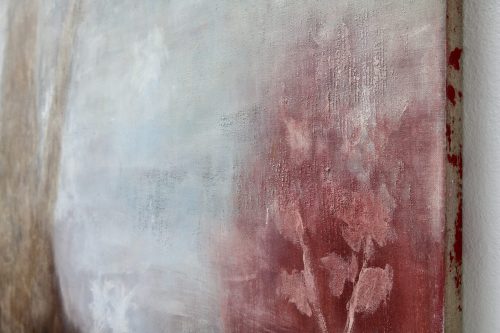
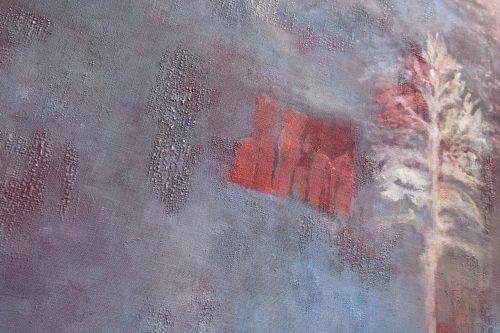
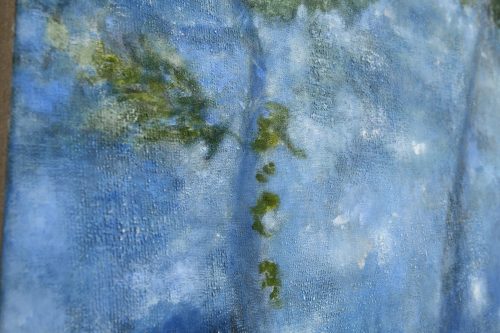
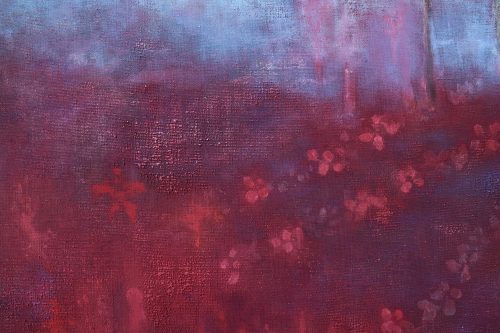
The painting quite literally extrudes gesso. Executed in tempera, it is built through successive layers of colour whose subtle manipulation produces unexpected spatial depth, compelling the viewer to reconsider the entire image.
The dialogue between the sculptural protrusions of gesso and the liquid, almost aqueous transparency of the paint generates a striking material tension.
How do these physical extrusions coexist with such atmospheric painterly depth? And how does this material complexity resonate with the absence of the figure? What kind of contemplative, almost liturgical vibration emerges from that absence?
After confronting these layered and often contradictory experiences, a final question inevitably arises. Does this process remove something from the Renaissance tradition, or does it add something essential to the language of contemporary art?
And how should we, as observers, respond to this call – perhaps the last one…?
| Francesco Sutton, Principal – Studio la Città
[1] In 2026, in his studio in Porto, Portugal, Lucas Reiner created nine canvases for the series “Renaissance Removal Paintings”, which are on display at Studio la Città from 16 May. For this series of works, the artist drew inspiration from biblical themes and retained the original dimensions of the masterpieces by some of the greatest masters of the European Renaissance: Piero della Francesca, Hieronymus Bosch, Giorgione, Andrea del Sarto, Titian, Paolo Veronese and Rubens.
[2] Lucas Reiner’s work Adam and Eve, or The Garden (reproduced in this document) draws on Peter Paul Rubens’s painting Adam and Eve in the Garden of Earthly Delights (1628–1629). Rubens, in turn, had drawn inspiration from Titian’s painting of the same name from 1550 – both paintings are on display at the Prado Museum in Madrid.