
MICHAEL LIGHT, Bravo Echo 1954-2023
SpazioTempo, Hotel de la Tresne, Bordeaux, France
open to the public from October 28, 2026 to January 7, 2027
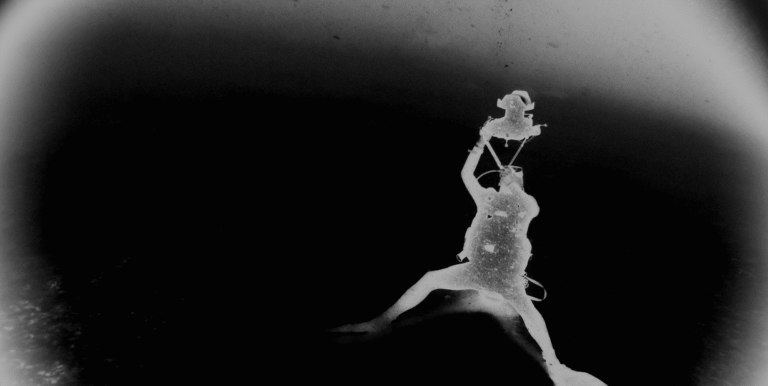
Michael Light, Bravo Echo, 4k video, 5:30 minutes video, 2023, frame still
Michael Light is not a filmmaker, humbly protesting: “I’m not known for that”, nevertheless I couldn’t stop watching Bravo Echo over and over; this is the video he made in the depths of Bikini Atoll, where the most horrifying nuclear weapon was tested in 1954[1]. I watched again, repeatedly, irresistibly hypnotized by the perfect beauty depicted and the perfect mirrored perversion of mankind emerging, magnificently filmed in black & white and masterfully turned to its negative.
it’s a powerful and existentially questioning work; five minutes immersed in silent waters tossed between devil and God, between Luciferian darkness and Archangel Michael’ light (excuse the paronym!). Only sharks and bubbles seem to animate the underwater landscape.
From the darkness of Immanuel Kant[2], where reason gropes at its own limits, to Aristotle’s luminous cosmic order[3]: here we see existential catharsis.
This may be the deeper meaning of this work: where do We stand at this day? How do we relate to these fundamental matters that may determine the future existence of the space we occupy? Are we just rational illuminati sliding bluntly into darkness?
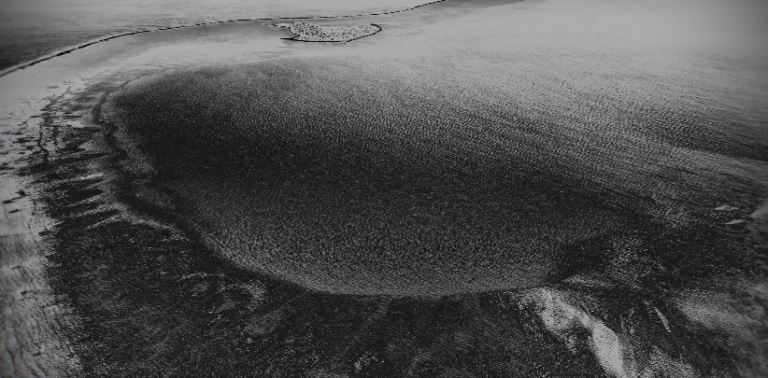
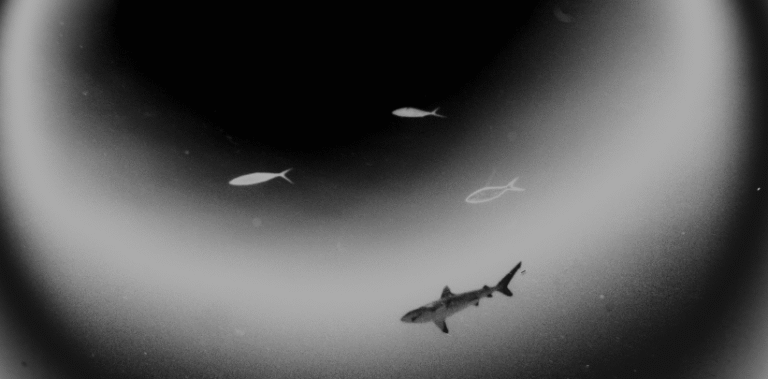
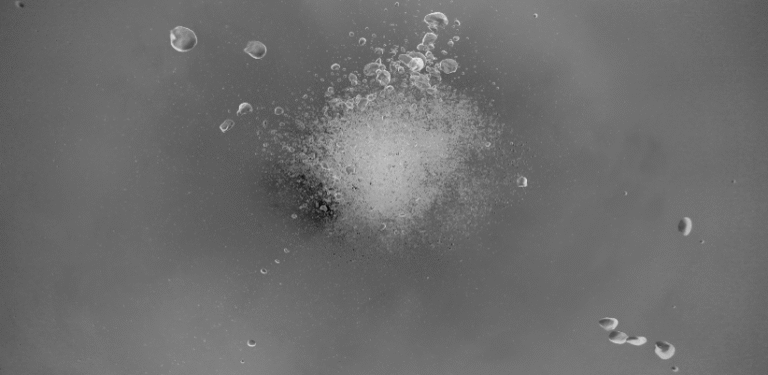
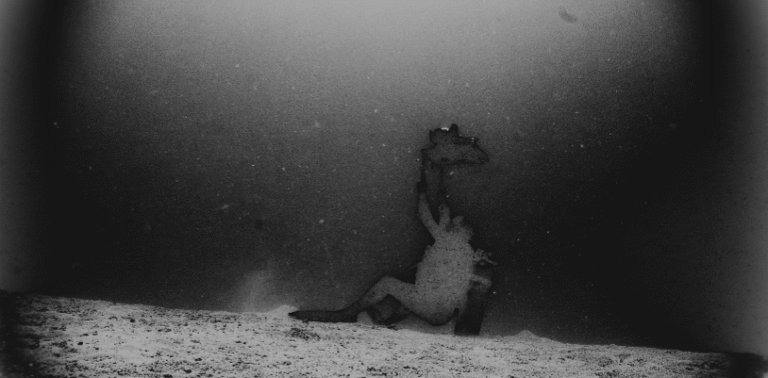
Michael Light, Bravo Echo, 4k video, 5:30 minutes video, 2023, frame stills
Mankind is now able to ignite its own star: capable of creating more light and more destruction than nature itself, our ambition would seem to be human perfection and control at the extreme; what is the dark motivation of this mental cascade? This might be the fundamental question raised in the depth of Michael Light’s questioning: the epitome of the meaning of “existential”.
In our specific and peculiar era, contemporary art can perhaps be seen as taking two conceptual directions: it either comfortably numb-s[1] the viewer through beauty and intellectual extraction from reality, or it artificially drowns him in a sea of “ir-relevant” literature with the most banal artistic tools.
Light’s art is different, it drives us down to observe and question the most radical issues, masterfully avoiding tedious morality while confronting eternal subjects such as space and time.
It’s a deep work on the human experience, passed, present and future.
Light offers a way to both be comfortable within the beauty of its content and to feel equally awkward about our larger underlaying intellectual understanding, while keeping all the key questions afloat.
| Francesco Sutton, Principal – Studio la Città
[1] This refers to the Castle Bravo nuclear test, carried out by the United States on 1 March 1954 at Bikini Atoll in the Marshall Islands. It was the first detonation of a solid-fuelled hydrogen bomb (code-named ‘Shrimp’). With a yield of approximately 15 megatons – almost a thousand times greater than the bomb dropped on Hiroshima – it exceeded the designers’ theoretical estimates by more than double, making it the most powerful device ever detonated by the US.
[2] In Religion within the Bounds of Mere Reason Immanuel Kant argues that humans have a “radical evil” in them, a built-in tendency to put self-love ahead of the moral law. Lucifer rebels because he wants to be a law unto himself. This is precisely and coincidentally at the heart of Kant’s philosophy: autonomy. Reason no longer accepts an order handed down from above but instead gives itself its own law.
[3] Aristotle, by contrast, describes an already ordered cosmology, the heavens are moved by separate intelligences, which the Scholastics, including Thomas Aquinas, identified with angels. Thus, angelic light is literally the light of the Aristotelian cosmos; Archargel Michael is Lucifer’s direct adversary: in the Book of Revelation, he leads the heavenly hosts and casts Lucifer out of heaven. His name means “Who is like God?”.
[4] Pink Floyd, Comfortably Numb (text by di Roger Waters, music by David Gilmour and Roger Waters), in The Wall, Harvest/Columbia, 1979