
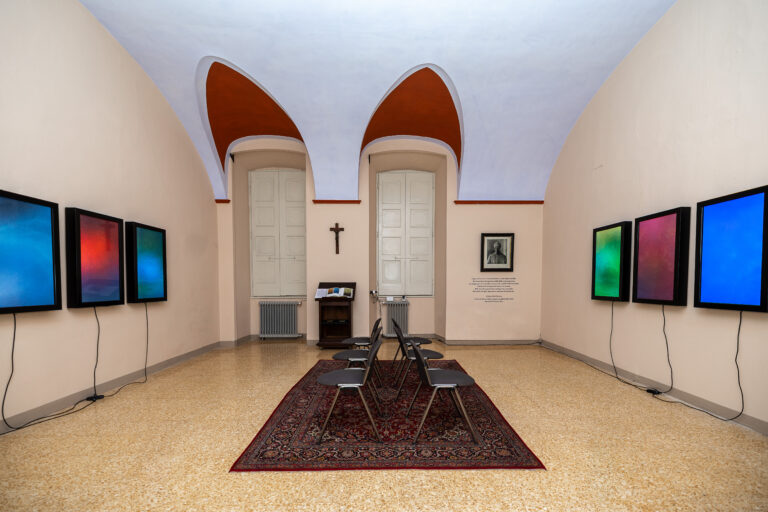
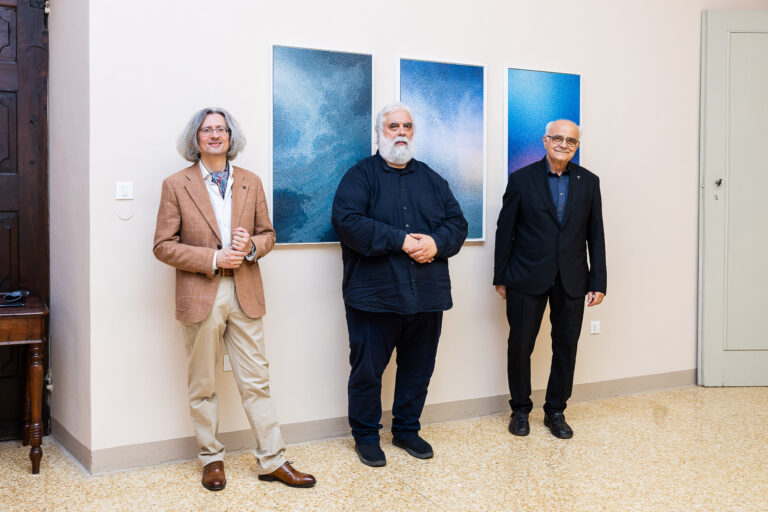
When contemporary art chooses to inhabit places steeped in historical memory, the result is often a metamorphosis of space and perception. This is exactly what happened in Stresa, on the shores of Lake Maggiore, where the historic Villa Ducale, the prestigious home of the International Center for Rosminian Studies, opened its doors for the first time to a contemporary art exhibition.
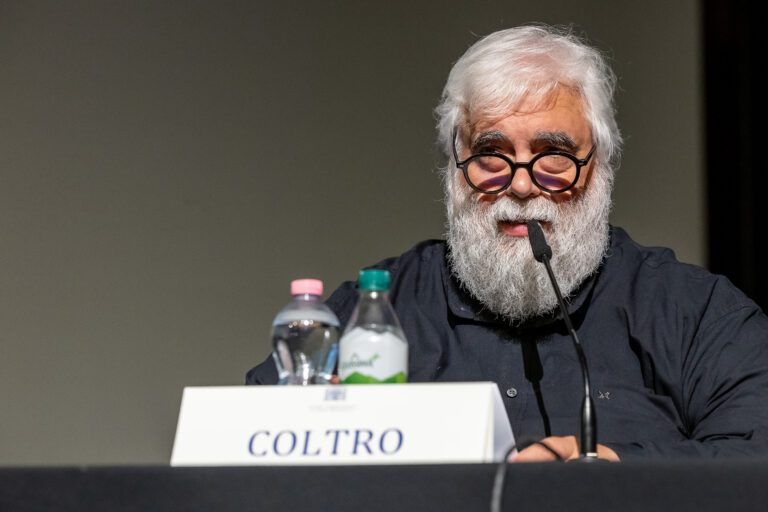
The protagonist of this cultural fusion is Davide Maria Coltro, a pioneer in Italy in the field of digital languages and electronic painting. Long a resident of the Alto Vergante area, in Gignese, Coltro was invited to take part in the Center’s annual Symposium, an event that has historically brought together philosophers, theologians, and educators. The goal? To introduce visual language as a privileged catalyst for inner transformation and a renewal of perspective.
At the heart of the installation presented at Villa Ducale are the artist’s famous “Quadri Mediali.” These works are not merely monitors, but rather true “generative canvases of electronic painting,” in which the traditional boundaries of the medium of painting dissolve to make way for ever-evolving flows of light, color, and time.
Through Coltro’s works, Villa Ducale demonstrates how its historical and archival heritage, which houses over 100,000 volumes and traces of an illustrious Risorgimento past, can engage openly with the languages of the present. An unexpected and fruitful encounter between the dematerialization of electronic painting and the solidity of philosophical reflection, confirming how contemporary art serves as both custodian and interpreter of humanity’s deepest questions.